


One of the final sessions at Nordic Lung Congress in Reykjavik was dedicated to pulmonary rehabilitation interventions for COPD-patients. Ideally, pulmonary rehabilitation programs are tailored to the patient and are supported by behavior change methods to boost long-lasting health enhancing behaviors. Ultimately, this can lead to improved physical and psychological condition of people with COPD.(1)
SPEAKER
Is HIIT a HIT in COPD?
Speaker: André Nyberg
Pulmonary rehabilitation is a cornerstone in COPD care. It is a non-pharmacological multicomponent approach that decreases dyspnoea and improves physical capacity for persons living with COPD. Recent research demonstrated the feasibility and safety of supramaximal HIIT in the COPD population, with fewer interruptions due to breathlessness compared to continuous exercise.
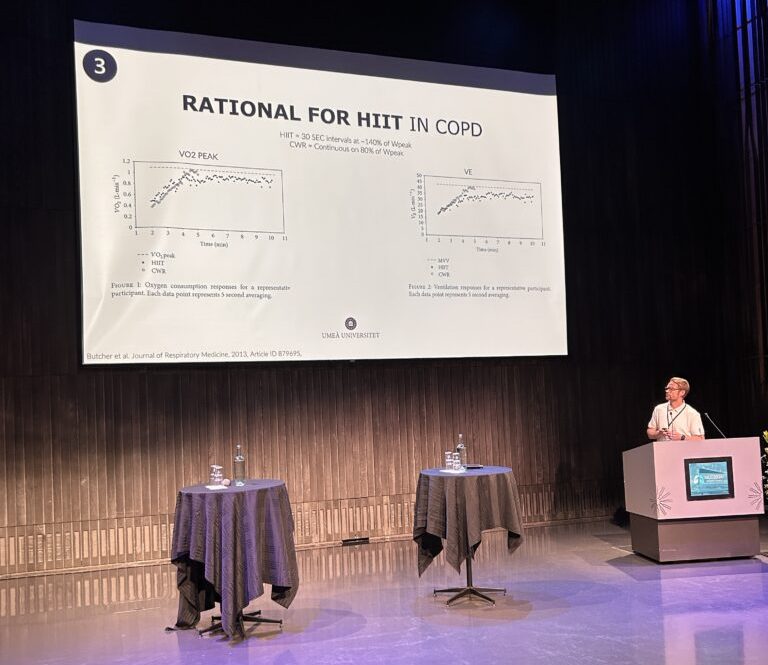
Minute ventilation is a limiting factor
Exercise programs for persons with COPD is often constructed with prolonged periods of continuous exercise. Recommendations for physical activity does not differ between COPD and the general population.²
However, as minute ventilation is often a limiting factor in the COPD population: the activity can only be sustained at a very low intensity, otherwise it has to be discontinued due to intolerable breathlessness. As a result, the training volume is insufficient for creating optimal peripheral physiological adaptations.
Super-maxxing the intensity
Professor André Nyberg from Umeå and his research group has in the past years directed their attention to High-Intensity Interval Training (HIIT) and explored applying this approach in COPD. With this type of exercise training, persons with COPD can exercise at very high intensities without being restricted by the minute ventilation. In a randomized crossover trial, they studied the feasibility and effect of an acute bout of exercise on a supramaximal intensity in a mild-to-moderate COPD population, compared to continuous exercise.³ The 10 HIIT-bouts consisted of 6 seconds exercise at 150% of maximal aerobic power, followed by a 54 second recovery. They found that all the participants completed the "SupraHIIT" session with no adverse events, while 5 of 16 participants interrupted the continuous exercise bout due to dyspnoea or exhaustion. These results support the feasibility of extremely high intensity exercise in this population and a superior success rate compared to regular continuous exercise.
A multidisciplinary approach to COPD is needed
For a physician with limited experience of exercise training, this type of exercise might sound difficult to perform or tough for patients. However, André pointed out that this is a basic training protocol for physiotherapists, exercise physiologist or any individual trained in sports science. Managing COPD is a heterogeneous disease requiring a multidisciplinary approach.
Collaboration with physiotherapists may help integrate HIIT as a key component of pulmonary rehabilitation programmes. Reach out to the physiotherapist at your hospital or clinic and discuss the possibility to improve the pulmonary rehabilitation program for COPD patients. HIIT could be included as key component.
FAKTA: NORDIC LUNG CONGRESS
Hva er Nordisk Lungekongress?
Nordisk Lungekongress (NLC) er en stor vitenskapelig og klinisk medisinsk konferanse som arrangeres annethvert år. Den fungerer som en sentral plattform for kunnskapsutveksling, nettverksbygging og presentasjon av den nyeste forskningen innen lungesykdommer og lungemedisin i Norden og Baltikum.
MER FRA NLC 2026
 Physical activity in COPD – can 6-second intervals help?
One of the final sessions at Nordic Lung Congress in…
 Why becoming smoke-free is not enough
A lung conference without a session on smoking is nearly…
 When it rains, it pours – multimorbidity in severe asthma
Almost every person living with severe asthma presents with at…
 Cleaner homes – more allergy? Exploring the epithelial barrier hypothesis
Unnur Steina Björnsdóttir explored the importance of epithelial integrity in…
Reference
- Reitsma MB, Kendrick PJ, Ababneh E, et al. Spatial, temporal, and demographic patterns in prevalence of smoking tobacco use and attributable disease burden in 204 countries and territories, 1990–2019: a systematic analysis from the Global Burden of Disease Study 2019. Lancet. 2021;397:2337–2360. doi:10.1016/S0140-6736(21)01169-7
- Arp S, Lund L, Bast LS. §RØG – en undersøgelse af tobak, adfærd og regler: udvalgte tendenser 2025, rapport 7. København: [Statens Institut for Folkesundhed, SDI]; 2026. 133 p.
- Ali FRM, Seaman EL, Crane E, Schillo B, King BA. Trends in US e-cigarette sales and prices by nicotine strength, overall and by product and flavor type, 2017–2022. Nicotine Tob Res. 2023;25(5):1052–1056. doi:10.1093/ntr/ntac284
- Grand View Research. Nicotine pouches market size & share, industry report, 2033. San Francisco (CA): Grand View Research; [cited 2026 Jun 9]. Available from: https://www.grandviewresearch.com/industry-analysis/nicotine-pouches-market-report
- Lyytinen G, Brynedal A, Anesäter E, et al. Electronic cigarette vaping with nicotine causes increased thrombogenicity and impaired microvascular function in healthy volunteers: a randomised clinical trial. Cardiovasc Toxicol. 2023;23:255–264. doi:10.1007/s12012-023-09802-9
- Antoniewicz L, Brynedal A, Hedman L, Lundbäck M, Bosson JA. Acute effects of electronic cigarette inhalation on the vasculature and the conducting airways. Cardiovasc Toxicol. 2019;19(5):441–450. doi:10.1007/s12012-019-09516-x
- Antoniewicz L, Kabele M, Nilsson U, Pourazar J, Rankin G, Bosson JA, Lundbäck M, et al. Chronic snus use in healthy males alters endothelial function and increases arterial stiffness. PLoS One. 2022;17(6):e0268746. doi:10.1371/journal.pone.0268746
- Hergens MP, Alfredsson L, Bolinder G, Lambe M, Pershagen G, Ye W. Long-term use of Swedish moist snuff and the risk of myocardial infarction amongst men. J Intern Med. 2007;262(3):351–359. doi:10.1111/j.1365-2796.2007.01816.x
- Hansson J, Galanti MR, Hergens MP, et al. Snus (Swedish smokeless tobacco) use and risk of stroke: pooled analyses of incidence and survival. J Intern Med. 2014;276(1):87–95. doi:10.1111/joim.12219
- Brinchmann BC, Vist GE, Becher R, et al. Use of Swedish smokeless tobacco during pregnancy: a systematic review of pregnancy and early life health risk. Addiction. 2023;118(5):789–803. doi:10.1111/add.16114
- Gunnerbeck A, Lundholm C, Rhedin S, et al. Association of maternal snuff use and smoking with sudden infant death syndrome: a national register study. Pediatr Res. 2023;94(2):811–819. doi:10.1038/s41390-022-02463-4
- Geerts CC, Bots ML, van der Ent CK, Grobbee DE, Uiterwaal CSPM. Parental smoking and vascular damage in their 5-year-old children. Pediatrics. 2012;129(1):45–54. doi:10.1542/peds.2011-0499
- Raitasalo K, Bye EK, Pisinger C, et al. Single, dual, and triple use of cigarettes, e-cigarettes, and snus among adolescents in the Nordic countries. Int J Environ Res Public Health. 2022;19:683. doi:10.3390/ijerph19020683
- Svanes C, Koplin J, Skulstad SM, et al. Father's environment before conception and asthma risk in his children: a multigeneration analysis of the Respiratory Health in Northern Europe study. Int J Epidemiol. 2017;46(1):235–245. doi:10.1093/ije/dyw151
- Kitaba NT, Knudsen GTM, Johannessen A, et al. Fathers' preconception smoking and offspring DNA methylation. Clin Epigenetics. 2023;15:131. doi:10.1186/s13148-023-01540-7

Erika Petersson
Medical Digital Content Manager, Chiesi
ID 22687-10.06.2026