


Clinical
Choosing the right inhaler and implementing improved inhaler technique in the clinic
Part of the joint session Inhaler technique, training and technology: making a difference for our patients across the world
Speaker
Omar S. Usmani (United Kingdom)
Why we still need to address inhalation technique
At the European Respiratory Society (ERS) Congress, Prof. Omar Usmani addressed inhalation technique for the tenth time—an indicator of its enduring clinical relevance. Despite advancements in inhaler technology, improper technique remains a major barrier to effective treatment in asthma and COPD.
Patient factors versus device factors
Two aspects should be considered in the choice of inhalers: The patient’s ability to use the inhaler (based on inspiratory effort, inhaler technique etc) and the device itself (design and engineering determining internal device resistance, aerosol velocity etc). In essence, in pressurized Multi Dose Inhalers (pMDIs), the actuations are powered by the device while Dry Powder Inhalers (DPIs) requires the patient to generate sufficient inspiratory force.2
Hidden cost of inhaler errors
A systematic review revealed that only 12% of healthcare professionals could correctly demonstrate inhaler use to patients.1 These errors are not trivial—critical inhaler errors are strongly associated with poor disease control, increased exacerbations, and higher healthcare costs.3
Device resistance and inspiratory flow: What prescribers need to know
Dry powder inhalers vary in their internal resistance. Devices with high resistance require a slow and steady flow. If the resistance is low, the inhalation needs to be quick and forceful. Resistance and flow work both have an impact on the activation of the powder.4 Studies in asthma and COPD show that mixing inhaler devices, requiring different flows and inhalation techniques, can lead to confusion and poorer outcomes.5,6
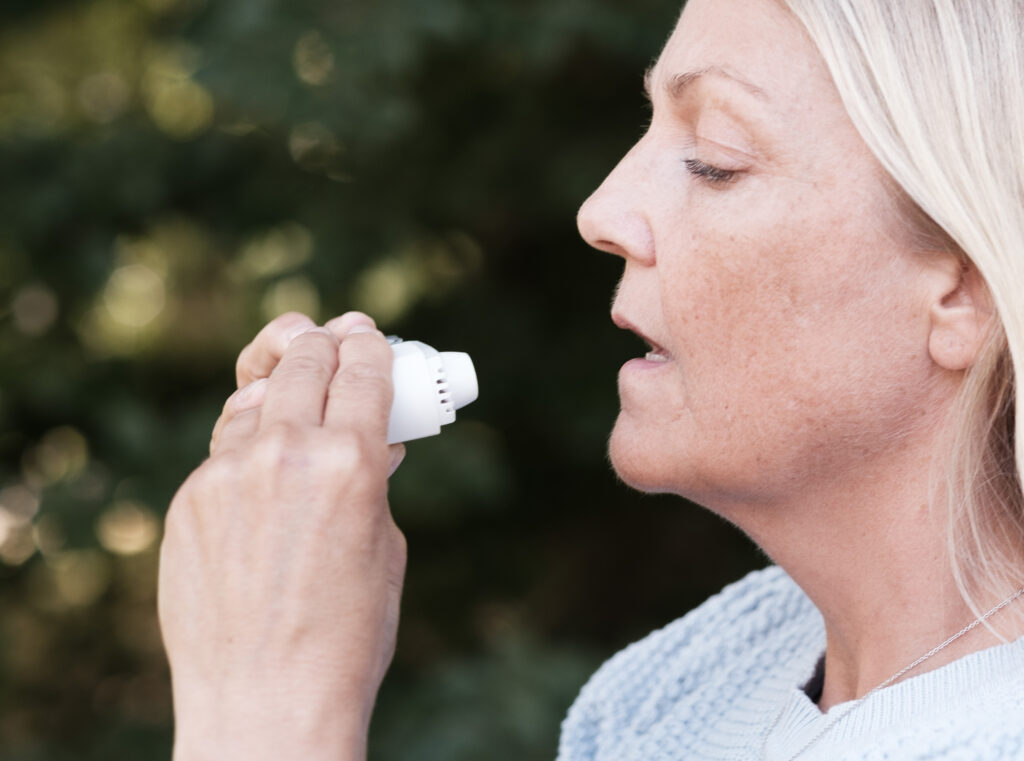
A 2022 study found that 29% of patients failed to generate sufficient peak inspiratory flow (PIF) for their prescribed device. These patients typically:
- Lack the muscle strength or physiological capacity for optimal PIF.
- Demonstrate poor inhalation technique or device misuse.
Notably, the highest rate of non-performers (i.e. not able to reach optimal PIF) was found in patients using medium-low resistance DPIs.7
ACT algorithm: A stepwise approach to optimal inhaler use
ACT – Assess, Choose, Train is an inhaler algorithm introduced recently in the ERS handbook8 to support clinical decision-making, breaking the decision-making into three steps:
| Assess | Evaluate the patient’s ability to perform the correct inhalation maneuver (e.g., slow and steady for pMDIs; quick and deep for DPIs). |
| Choose | Select an inhaler based on the patient’s capability, ideally considering environmental impact (e.g., low-carbon pMDIs or DPIs). |
| Train | Provide education through face-to-face sessions or instructional videos to reinforce proper technique. |
Post-exacerbation inhaler strategy
Patients discharged after exacerbations often have weakened respiratory muscles. In such cases, pMDIs or soft-mist inhalers—which do not require forceful inhalation—are preferable. This approach may reduce 30-day readmission rates.9
Sustainabilty in practice – green goals and patient safety
Efforts to reduce greenhouse gas emissions are important and must be balanced with patient safety. A large US study involving 260,268 patients examined blanket remote switches from pMDIs to DPIs.10 The switch, driven by environmental and cost concerns, was associated with:
- 5–24% increase in emergency department visits.
- Higher rates of hospitalizations for respiratory and pneumonia-related conditions.
These findings highlight the risks of non-individualized switching strategies.
Inhaled volume – a digital biomarker
Prof. Usmani also emphasized the potential of inhaled volume as a digital biomarker for predicting outcomes in chronic respiratory diseases.11 He reminded clinicians of a simple but crucial step: ensuring patients exhale fully before inhalation to maximize drug delivery to the lungs.

Pekka Ojasala
Medical Advisor, Chiesi Nordic
References
- Usmani OS. Choosing the right inhaler for your asthma or COPD patient. Ther Clin Risk Manag. 2019 Mar 14;15:461-472. doi: 10.2147/TCRM.S160365. PMID: 30936708; PMCID: PMC6422419.
- Plaza V, Giner J, Rodrigo GJ, Dolovich MB, Sanchis J. Errors in the Use of Inhalers by Health Care Professionals: A Systematic Review. J Allergy Clin Immunol Pract. 2018;6(3):987-995. doi:10.1016/j.jaip.2017.12.032
- Usmani OS, Lavorini F, Marshall J, Dunlop WCN, Heron L, Farrington E, Dekhuijzen R. Critical inhaler errors in asthma and COPD: a systematic review of impact on health outcomes. Respir Res. 2018 Jan 16;19(1):10. doi: 10.1186/s12931-017-0710-y. PMID: 29338792; PMCID: PMC5771074.
- Capstick TGD, Gudimetla S, Harris DS, Malone R, Usmani OS. Demystifying Dry Powder Inhaler Resistance with Relevance to Optimal Patient Care. Clin Drug Investig. 2024 Feb;44(2):109-114. doi: 10.1007/s40261-023-01330-2. Epub 2024 Jan 10. PMID: 38198116; PMCID: PMC10834657.
- Price D, Chrystyn H, Kaplan A, Haughney J, Román-Rodríguez M, Burden A, Chisholm A, Hillyer EV, von Ziegenweidt J, Ali M, van der Molen T. Effectiveness of same versus mixed asthma inhaler devices: a retrospective observational study in primary care. Allergy Asthma Immunol Res. 2012 Jul;4(4):184-91. doi: 10.4168/aair.2012.4.4.184. Epub 2012 Apr 6. PMID: 22754711; PMCID: PMC3378924.
- Bosnic-Anticevich S, Chrystyn H, Costello RW, Dolovich MB, Fletcher MJ, Lavorini F, Rodríguez-Roisin R, Ryan D, Wan Yau Ming S, Price DB. The use of multiple respiratory inhalers requiring different inhalation techniques has an adverse effect on COPD outcomes. Int J Chron Obstruct Pulmon Dis. 2016 Dec 21;12:59-71. doi: 10.2147/COPD.S117196. Erratum in: Int J Chron Obstruct Pulmon Dis. 2019 Aug 02;14:1739. doi: 10.2147/COPD.S156325. PMID: 28053517; PMCID: PMC5191843.
- W H Kocks J, Wouters H, Bosnic-Anticevich S, van Cooten J, Correia de Sousa J, Cvetkovski B, Dekhuijzen R, Dijk L, Dvortsin E, Garcia Pardo M, Gardev A, Gawlik R, van Geer-Postmus I, van der Ham I, Harbers M, de la Hoz A, Janse Y, Kerkhof M, Lavorini F, Maricoto T, Meijer J, Metz B, Price D, Roman-Rodriguez M, Schuttel K, Stoker N, Tsiligianni I, Usmani O, Leving MT. Factors associated with health status and exacerbations in COPD maintenance therapy with dry powder inhalers. NPJ Prim Care Respir Med. 2022 May 26;32(1):18. doi: 10.1038/s41533-022-00282-y. PMID: 35618739; PMCID: PMC9135702.
- ERS Handbook of Respiratory Medicine. (2025). In European Respiratory Society eBooks. https://doi.org/10.1183/9781849842037.erha4
- Loh CH, Peters SP, Lovings TM, Ohar JA. Suboptimal Inspiratory Flow Rates Are Associated with Chronic Obstructive Pulmonary Disease and All-Cause Readmissions. Ann Am Thorac Soc. 2017 Aug;14(8):1305-1311. doi: 10.1513/AnnalsATS.201611-903OC. PMID: 28406710.
- Rabin AS, Seelye SM, Weinstein JB, Hogan CK, Whittington TN, Cano J, Miller SA, Kelley C, Prescott HC. Budesonide-Formoterol Metered-Dose Inhaler vs Fluticasone-Salmeterol Dry-Powder Inhaler. JAMA Intern Med. 2025 Aug 1;185(8):1005-1013. doi: 10.1001/jamainternmed.2025.2299. PMID: 40622686; PMCID: PMC12235531.
- Chrystyn H, Milton-Edwards M. Inhaled Volume as a Digital Biomarker Predicting Outcomes in Chronic Respiratory Disease. J Aerosol Med Pulm Drug Deliv. 2025 Jul 2. doi: 10.1089/jamp.2024.0063. Epub ahead of print. PMID: 40601489.
ID17113-07.10.2025